Three days ago, I wrote a poem. For those who write lots of poems, all the time, the response would probably be - so what? But for me, after completing a first draft, it was a moment of - what took so long? How could I have gone more than a month without writing a single poem? For those who write no poems, the response would probably be - what's the big deal? But it set me thinking about how poetry really is always in my life, even if sometimes it goes off on a holiday for a while.
I've been writing poems since I was 18 years old. I can pinpoint that as my starting year because before then, I had no idea what poetry was. I went to a high school where we studied no poetry AT ALL until 6th form (now equivalent to Year 11). In that year, I only remember two poems we read in class - one about a girl running away through the woods, and one by Robert Graves, but I don't remember which. I do know it was enough to send me off looking for more by him, and discovering "Love is a migraine".
When I first dared to write my own, they were awful. Full of angst and terrible rhyme. I kept the rhyme and later, when I was travelling, I would write funny rhyming poems to make people laugh. I still remember the first poetry class I ever did with Bev Roberts, where I wrote a 4-line free verse poem about autumn (a writing exercise) that she liked, and she told me it had a great metaphor in it.
My response? What's a metaphor?
I laugh now, but at the time it was like having my eyes opened to a magical world of language and images, where I could write whatever I wanted, about whatever I felt or saw or experienced, using language in new and different ways to anything I'd ever done before. It was the world of free verse.
Since then, I've probably written hundreds, if not thousands, of poems. I've written four verse novels. I've written free verse, forms such as villanelles and sestinas, and prose poems. I've taught poetry writing to hundreds of people, from kids to teens to adults.
Still, at the heart of all of this is language and expression and "getting things off my chest and onto the page". Maybe when I don't write much poetry, I'm not aware enough of the world to find a subject. More likely, I don't write much poetry when I'm working hard and deep into a novel, as I am right now. But when I stop and pop my head up, often a poem or two arrives to greet me.
What does poetry do for me? Self-expression, as I said. For every poem that gets reworked and perhaps published, there are usually four more that stay in my notebook. But more importantly, poetry feeds into all of my writing. Reading poetry makes me aware of what language can do, what I can create with language myself. It makes me aware of how important it is to try new things, new ideas, look for new horizons. It reminds me that there are lots of fellow poets out there, doing as I do, because it's important and valuable and meaningful to them, too. Reading their poetry shows me what is possible, and often sparks new ideas for me.
Writing poetry feeds into my prose writing - it flexes my language muscles, provokes me into better imagery, stronger rhythm, more precise word choices. It reminds me of sensory details, of the telling detail, of voice and cadence. Writing poetry reminds me I am a writer. It allows me to focus on a moment, an image, an idea, with complete and utter attention.
This is why I am always going on to people about the importance of poetry to children and teenagers, about how much we lose when we don't have poetry in schools. We don't have to "teach" poetry. That, in unskilled, uninterested hands, can kill poetry forever in a child. But we should at least be reading poems to kids every day or every week, putting poetry on the fiction shelves in libraries instead of away in the 800s, and making good poems available at every opportunity. I'm sure that if I'd been given a whole pile of good contemporary poems to read in high school, it would have made a big difference to me. The few I did get still resonate with me today.
What about you?
Friday, October 04, 2013

Thursday, September 19, 2013
Reviews: "The 5th Wave" and "The Green Glass Sea"
We've been inundated with post-apocalyptic and dystopian novels for quite a while now (well, it seems like a long while but I guess the vampire years seemed endless, too), so in the wake of The Hunger Games, it's hard to stand out from the crowd. Initially I heard a lot of good things about The 5th Wave (by Rick Yancey) and then some not so good things (i.e. nothing new, weak characters) so I put it on my "read later" pile, mainly because I was writing a SF novel at the time and didn't want to be distracted.

Then I picked it up. It's hard to read this book without mentally referencing every other novel and movie you've read or seen, that's for sure. I kept seeing pictures in my head of scenes from Independence Day at first, but I did eventually get past that. I don't think the opening line helped: Aliens are stupid. It's the kind of first line designed to snag you in, but is actually misleading. Never mind. I kept reading.
The first point-of-view character is engaging, a girl who ends up alone. One of the few who are immune to the plague that came with the 3rd wave (spread by birds). The waves that the aliens unleash on the world are logical ways to get rid of billions of people, as long as you're happy to wait out the rotting process in your space ships in orbit. The premise of all of this mostly worked for me. What didn't work quite so well was the change of POV narrator, flagged only by a page that said: II - Wonderland.
Took me several pages and some re-reading to work out that I was with a entirely new character. I have to admit I'm likely to get snarky about this in any novel. It's not so hard to signal that to the reader, truly. You're not spoiling anything! There are lots of interesting elements in the novel, including armies of child soldiers and the notion of aliens watching Earth for decades before moving in (not new). Mostly what kept me engaged were the characters. I will say, though, that I suspect if this book ever makes it to the big screen, they'll focus on the special effects and ramp up the Katniss-Everdeen-type female character and the big battles, and a lot of the more interesting stuff will be lost. We'll see.
 The Green Glass Sea was an unknown - one of the reasons we still love bookshops. You wander, you browse, you pick up things that look interesting and you take home something you might never have discovered otherwise. Thus I found this book in Chicago and thought - a historical novel set around Los Alamos and the development of the nuclear bomb - from a child's point of view. Great!
Dewey Kerrigan is eleven and her sole parent dad is helping other scientists to build a "gadget". She moves to Los Alamos and lives on The Hill, which is the compound where all the families live while the parents work on the bomb. The second narrator is Suze, who just wants to be friends with the "it" girls and resents having to share with Dewey, who is weird and gets stuff from the dump and builds things. Part of the tension of the story comes from us as readers who know the bomb not only worked but was used on Japan.
But we also know that the testing took place with far-reaching ramifications - the long-term effects of radiation on the environment and the families who picnicked while they watched the bright light and mushroom cloud. We also worry for the kids - what will this mean to their families, their parents, their lives? In any enclosed, isolated community, strange things can happen. The author, Ellen Klages, seems to mostly write science fiction, but this is not SF - it's a terrific historical novel that will bring all the realities of the atomic bomb and its use alive for kids (and adults, I think).
Then I picked it up. It's hard to read this book without mentally referencing every other novel and movie you've read or seen, that's for sure. I kept seeing pictures in my head of scenes from Independence Day at first, but I did eventually get past that. I don't think the opening line helped: Aliens are stupid. It's the kind of first line designed to snag you in, but is actually misleading. Never mind. I kept reading.
The first point-of-view character is engaging, a girl who ends up alone. One of the few who are immune to the plague that came with the 3rd wave (spread by birds). The waves that the aliens unleash on the world are logical ways to get rid of billions of people, as long as you're happy to wait out the rotting process in your space ships in orbit. The premise of all of this mostly worked for me. What didn't work quite so well was the change of POV narrator, flagged only by a page that said: II - Wonderland.
Took me several pages and some re-reading to work out that I was with a entirely new character. I have to admit I'm likely to get snarky about this in any novel. It's not so hard to signal that to the reader, truly. You're not spoiling anything! There are lots of interesting elements in the novel, including armies of child soldiers and the notion of aliens watching Earth for decades before moving in (not new). Mostly what kept me engaged were the characters. I will say, though, that I suspect if this book ever makes it to the big screen, they'll focus on the special effects and ramp up the Katniss-Everdeen-type female character and the big battles, and a lot of the more interesting stuff will be lost. We'll see.
Dewey Kerrigan is eleven and her sole parent dad is helping other scientists to build a "gadget". She moves to Los Alamos and lives on The Hill, which is the compound where all the families live while the parents work on the bomb. The second narrator is Suze, who just wants to be friends with the "it" girls and resents having to share with Dewey, who is weird and gets stuff from the dump and builds things. Part of the tension of the story comes from us as readers who know the bomb not only worked but was used on Japan.
But we also know that the testing took place with far-reaching ramifications - the long-term effects of radiation on the environment and the families who picnicked while they watched the bright light and mushroom cloud. We also worry for the kids - what will this mean to their families, their parents, their lives? In any enclosed, isolated community, strange things can happen. The author, Ellen Klages, seems to mostly write science fiction, but this is not SF - it's a terrific historical novel that will bring all the realities of the atomic bomb and its use alive for kids (and adults, I think).
Tuesday, September 03, 2013
Mr Ultimate Mapmaker!
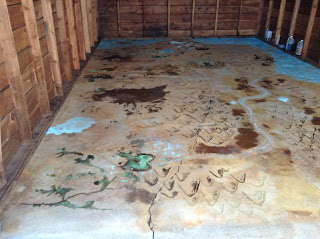
One of my fellow Hamline students, Michael Petry, is doing his critical thesis on maps in novels this semester, but what intrigued me was the huge map Mike has created on his garage floor! So of course I had to ask him more about that, and maps, and writing and stuff...

Why do you think writers and readers find maps so interesting?

Do you think maps are always necessary in fantasy novels? What other fiction books have maps?

What benefits are there for a writer to create a map, even if it doesn't go into the final book?

Oh my name implies my interest too, Michael
Adam Petry (MAP) kind of cool huh.
Thanks, Michael! I think your garage floor is amazing!

Where did
your interest in maps come from? Is it only maps in books (like fantasy novels)
or all kinds of maps?
My
undergraduate degree is in Landscape Architecture and Environmental Planning.
The founder of Landscape Architecture was Frederick Law Olmsted. He designed
New York City’s Central Park and many other wonderful parks and cities as well.
My interest in maps grew from there although if I think about it I’ve always
been fascinated with knowing where I stand. Maps in novels to me are a
wonderful bonus. Some books would probably be just fine without them but with
them we know where the story is taking place and how that character moves
through his environment. I really like all kinds of maps.
I’ve spent
seven years as a civil engineer. I’ve drawn maps of new roads, sewer systems,
water systems and storm drainage systems. The coolest part of doing that type
of work is that these maps or plans have been built and people use and live in
them today.
Why do you think writers and readers find maps so interesting?
Maps ground
us, they give some sense to what lies ahead. Maps give both the writer and reader
a sense of the setting. Are we near a river or a seaside, in a mountain valley
or the Dead Marshes found in JRR Tolkien’s Lord of The Rings? Personally I love
to know the path that a character has made through a map and if there is a map
with a novel and the story mentions places that are not on the map it can be a
bit frustrating.

Do you think maps are always necessary in fantasy novels? What other fiction books have maps?
I don’t think
the maps are a necessity in fantasy novels. Like Ron Koertge mentioned this
summer at Hamline, they can aid in the writing process and help move the plot of
the story forward. I’m not one hundred percent sure but the more I have thought
about this the more it seems to make sense. If you have a character in your
story that moves through a space that he/she interacts with, more than just
passing through, then a map is needed to get the writer to be consistent. This
deals with a sense of scale as well too.
I just finished reading Patrick
Rothfuss’s King Killer Chronicles
where Kvothe spends a great deal of time at the University. Patrick drew up the
University. These smaller scale places like a University or Hogwarts tend to be
three dimensional. Often the main character explores and gets to know these
spaces much more than any flat character would ever dream of. For example,
Kvothe goes to classes just like the rest of his schoolmates but he spends time
on the roof tops of the University buildings and spends time below in the sewer
ways and steam vents and finds running water and tunnels his way into places
that are off limits to him. Harry Potter does the same thing at Hogwarts. These
places and the maps that are either quickly sketched up or meticulously drawn
out become part of the stories’ characters.

What benefits are there for a writer to create a map, even if it doesn't go into the final book?
First and
most importantly they are fun but maps will map the writing process out. If you
know that Christopher Paolini’s Eragon and his dragon Saphira are traveling
with some dwarves and an elf on the eastern edge of the map from the Beor
Mountains down the Az Ragni River eventually to end up in the elf city of
Ellesmera in the Du Weldenvarden forest you have much of the plot laid out for
you not to mention all the cool setting that they get to travel through. All
kinds of cool adventure can happen but you know that your character will start
at point A and end up at point B, aiding in moving your plot forward.

What inspired you to create the map on your garage floor? Can you tell me about
it - where, when, what, how?
My Critical
thesis is what started it really. I’ve wanted to create a place away from my
wife and three daughters that I can call my own, to write and be inspired by my
surroundings. The cool thing about what I drew up on my garage floor is that it
isn’t any place just yet. I have a coast line, some mountain ranges, some
swampy areas, and dry arid climates too. I think that the when is the question
I can answer right now, I’m jumping head first into my critical thesis and
surrounding myself with maps.
Anything else you want to add?
Anything else you want to add?
Thanks, Michael! I think your garage floor is amazing!
Wednesday, August 21, 2013
Try a mini verse novel!
Recently, I was asked to teach a poetry workshop on longer
works, specifically sequences and verse novels. It gave me a chance to pull out
all the terrific books, collections and verse novels I’d read over the past few
years, in order to share them with the group. Everything from Dorothy Hewett’s
“Upside Down Sonnets” to picture books such as Janet Wong’s Night Garden and my own Now I Am Bigger to verse novels by Helen
Frost, Karen Hesse, Sharon Creech and Allan Wolf.
I like to think of a poetry sequence as a mini verse novel,
although not all sequences work this way. But where a sequence tells a story, I
think it can. It means you can write ten or twelve poems (or more) that have a
narrative behind them, and start to consider the other elements that a verse
novel has.
These include voice and character, for a start, but also a
sense of progression. Where are you taking the reader? Are you simply showing
them different aspects of the same thing? A short example of this is Wallace
Stevens’ “Thirteen Ways of Looking at a Blackbird”, where each small poem is
numbered. I would call this a “poem in parts” – you could stretch it to a
sequence. I’ve seen poets who write, for example, a series of poems about their
father or mother, or about a childhood or life event. Again, those poems fit
together because they are about one thing, but they still would not be a mini
verse novel to me.
A mini verse novel may well be the short story equivalent to
the novel (of the novel?). It means
you don’t have to write a book-length work, but you can still explore a
narrative through poetry. Think of it as a short story in poems.
So these are the elements I think are important in a mini
verse novel:
- · A balance – too much poetry or not enough narrative and it doesn’t work – you end up with chopped-up prose, or poems with no connections.
- · Poetic elements of figurative language and keen attention to line breaks and stanzas
- · It needs to be a story that will tell better in poetry, and it does need to have the elements of a story in terms of beginning, middle and end
- · A story that needs a lot of explanation or setting or dialogue etc generally won’t work
- · Rhyming the whole thing may kill you if you are not proficient at rhyme and form (look at Helen Frost’s work if you want to see it done really well)
- · Read, read, read what other verse novelists are doing – and learn to read critically – don’t accept that everything that says it is a verse novel actually is
- · Outlining will help but if you need to work by instinct, do – just be prepared to throw some poems out later
- · And be ruthless in revision
- · Recognise that much of the story will lie in the white space and you will need to learn how to use the white space as well as the language.
·
When it feels like you have enough poems, stop.
Give it some time, then go back and ask yourself what is the story you want to
tell, and which two poems will start and end it. Those are your lighthouses.
Wednesday, August 14, 2013
Australian writers - the rock and the hard place
Despite gloomy forecasts and sliding graphs recently, e-book
sales are not nosediving. But here in Australia, I think the global effects of
e-books are only just starting to sink in, especially with writers. This is not
a whine or a rant, by the way, this post is a business discussion. What is the rock? Australian
publishers who, when you sign a contract with them, demand ALL rights, which
means world rights and e-rights. You need to have a lot of clout to get this
amended or changed.
What is the hard place? Very few Australian books are sold
to overseas publishers. We hear a lot about books like The Rosie Project, Burial
Rites and Diary of a Wombat (not
to mention The Book Thief and Jellicoe Road) and how many overseas
territories they have sold to, especially the USA. But they are the exception,
not the rule.
For most Australian writers, especially children’s writers,
it’s unlikely the overseas rights on
their books will be sold, especially if the book is deemed “too Australian”.
That means the market is Australia (and sometimes NZ). It’s a small market, and
getting smaller. If someone from the USA
wants to buy an Australian book via an online bookseller here, they will very
likely pay $25-30 for a small paperback, because of the horrendous postage
charge.
Aha, you say, but now we have e-books. We sure do. But even
if your publisher releases your book as an e-book, it’s very likely they will
limit availability to Australia. If they do decide to sell it “world wide”, how
will anyone know about it unless YOU tell them? (To put this another way, how
do readers in other countries hear about Australian books without a marketing
campaign of some kind in their
country?)
If you’re Tim Winton or someone who has an international
reputation already, it’s not an issue. But Winton’s books already sell overseas
as print books, so a globally available e-book is obviously going to sell.
Aha, you say, what if you sell your book to a US publisher
first? You get an agent over there, they sell your book, and Bob’s your auntie.
You have two options: you can hold back Australian/NZ rights and sell them
separately, or you can let the US publisher keep them and either sell your book
to an Australian publisher or import it here. Here’s the other rock and hard
place – if you’ve already sold US rights (and e-rights), it’s highly unlikely
an Australian publisher is going to want your book, unless it becomes a best
seller over there. The prospective rights that might earn them good money are
already gone.
If the US publisher is allowed to import your books here
after 90 days (if they decide it’s worth it) because nobody here wants to
publish it, you’re going to be responsible for most of the marketing. That
means a heck of a lot more than some FB and Twitter posts! Same goes for if the
US publisher releases your book as an e-book. The big word in publishing and
marketing now is “discoverability”. Who else is going to get your book noticed
except you? A US or UK publisher is already dealing with that in their own
markets.
And there are a number of awards here that require the book
to be published in Australia, not
published elsewhere and imported.
Why am I writing about this? Because it’s an issue that’s
come up for me several times over the past few years, and e-books have actually
made it more complicated, not less. I’ve experienced these difficulties in
various ways and permutations, and so far, there is no easy answer. I
completely understand publishers’ need to stay solvent and do good business,
but …
There are lots of aspects to this issue. Print books are not
going away, but e-books don’t look like they are going to be the income earner
that a lot of writers were hoping for. It’s not even a territorial copyright
issue, really. I’d be interested to hear from other Australian writers with
similar experiences of the rock and the hard place.
Subscribe to:
Posts (Atom)
-
 Lee Child, Fiona Veitch Smith, Linda Mather, Sherryl Clark (c) Sherryl Clark 2025 When I knew I was going to Europe, which initially was t...
 -
In the way that these things sometimes do, writers who have decided to stop writing has come up as a topic several times in the past few mon...
-
Today I went for my usual walk, and it occurred to me that my 20 minutes+ is a little like a novel. I start out a bit slowly, with joints an...