Wednesday, December 11, 2013

Refilling the Creative Well

At this time of year, anyone who writes and also has a job (to pay the bills) is hanging out for the December-January break, because that's the time when you can read and get fully back into writing. That's if you don't have a million family commitments. If you teach, this also tends to be the one time of the year when you can stop filling your head with other people's writing and focus on your own.

BUT. It's not that easy. Nine months of other people's writing has done more than fill your head and sap your energy. It has, in the words of a Hamline faculty member, Jane Resh Thomas, drained the well. Like many writers who teach, Jane has experienced what it means to have a well of creativity that gradually runs dry. After all, you're not doing your teaching job very well if you hold everything at a distance and treat grading and feedback like a multi-choice performance review. But when you put your passion into teaching and other people's writing, you pay.

I'm not complaining about teaching writing. I love it, and always have. So do the other writing teachers I know. But we also know that when it comes to the well, by December it's pretty well at rock bottom. Just a few inches of dry dust down there ...

So how do you re-fill the well? Here are some ideas:

  • Reading. I save books for the end of the year, books that I'm too tired to read up till now, books that are pure escapism, books that I know will feed my creative brain. One year it took me all 12 months to work up to The God of Small Things but was it ever worth it! This year I have a stack that includes Junot Diaz, Ron Rash, Amy Espeseth, Ransom Riggs and even a Jonathan Franzen.
  • Poetry. Every writer should refill their well with some poetry. I'll be re-reading some old favourites, but I've re-signed to receive a Poem a Day, and I have some anthologies saved up, plus I will probably buy Best Australian Poems for this year.
  • Free writing and journalling. It's great to start a new project or get back to work on a novel or project you've had to keep putting aside all year, but taking time to get in touch with the joy of simply writing, with no outcome other than "oiling the cogs", will benefit all the other writing you do.
  • Find a couple of writing blogs to inspire you and make you feel less alone and more "in tune" with the writing world again. One of my favourites is Writer Unboxed, simply because every post is different and yet helpful. I also like Kristen Lamb's blog - I like her honesty and sense of inclusion. As she says, We are not alone.
  • Stay in touch with fellow writers like yourself. If you need to feel re-inspired and get writing again, have a coffee with someone who feels like you - not someone who never writes or who spends all their time complaining and making excuses. You know who the valued writing friends are - get together and talk writing and books!

I haven't been teaching this year but I have been studying and writing full-time, and my well is a bit dusty, too, from finishing two completely different novels. I need some time-out before I start the next one, so I've been doing the one other thing that makes me feel creative and industrious again (goodness only knows why!). I've been spring cleaning my office! Apart from creating large piles of rubbish for the bin, I've also been finding poems and stories that are ready for another draft, notebooks and random pages of ideas, and more books that I'd put away to read later. I'm starting to feel re-inspired already.

Tuesday, December 10, 2013

Books for Christmas gifts!

It's always good to have extra recommendations for gifts at this time of year, and books are the best of all! I try to buy every child in our family at least one book, and sneak books into other people's parcels, too. And of course if someone asks me what I'd like, I have a handy list of half a dozen titles to give them.

If you have someone who's about to start school next year, you can't go wrong giving them My First Day at School by Meredith Costain. Ari, Amira, Zoe and Zach experience their very first day, with all the trials and tribulations, as well as the fun. First day can be scary (I can still remember the disgust I felt at being made to take a nap after lunch!). The story delves into reading, drawing, pasting, eating and whether they'll make it to the toilet in time. (Ah, it's all coming back to you now, isn't it?) The illustrations are very cute and little kids will love all the faces and actions.

I think the best YA novel I've read this year would be a dead heat between Eleanor and Park by Rainbow Rowell and Out of the Easy by Ruta Sepetys. I'd heard a lot about Eleanor and Park and it lived up to the goss. A novel that startles and enlightens at the same time, and totally engaging and interesting characters. One of my good Hamline friends lent me Out of the Easy (sorry, I still have it!), which I would never have come across otherwise here in Australia. It's set in 1950, in the French Quarter of New Orleans where Josie works in a bookstore and struggles with having a mother who is a brothel prostitute. Lots of atmosphere, danger, secrets and hope.

I've read lots of crime fiction (probably more than I should!) but I think my No. 1 spot has to go to Michael Robotham's Watching You. Joe O'Loughlin is a clinical psychologist who gets involved with Marnie, a woman who is convinced someone is watching her. Meanwhile, she's also trying to deal with a husband who has been missing for over a year. There are plot twists in every chapter and the book was impossible to put down. Also on my list for "goodies" was Peter James's latest, Dead Man's Time and Just One Evil Act by Elizabeth George.

Finally, since I was just about the only person in the world who didn't like Gone Girl by Gillian Flynn, I approached my review copy of The Next Time You See Me by Holly Goddard Jones with wariness (because it spruiked Gone Girl on the cover). There are quite a few characters in this novel but they're easy to remember because they are all so different and well-portrayed. There's a body in the gully that seems to move around, and people who may or may not be missing - in other words, lots to keep you guessing without being tricksy. The creepiest character for me was thirteen year old Emily - the kind of kid you'd expect to find in a Stephen King novel!

Wednesday, December 04, 2013

Where do you get your ideas from?


 It’s a question I get asked over and over (as many writers do, I’m sure), and I was asked again recently.  “How do you get your ideas?” There’s actually no easy answer, but I always remember something I was told years ago – “Ideas don’t usually come knocking on your door. You have to go out there and hunt them down.”
 
There are quite a few myths about ideas. One is that there is a limited number and if you get a good one, you have to hang onto it and make it work. I see lots of people in my classes who cling doggedly to what they think is their one and only idea and work it to death, and then wonder what happened. 

Another is that a really good idea can’t possibly come from a writing exercise. Some writers regard that as a kind of cheating, as if the idea somehow belongs to the person who gave them the writing exercise. Some of my best poems and stories have come from exercises. Then there’s the myth that a great idea will come in a huge flash like a revelation, so all those other ideas you might have are not as “worthy”.

It’s true that writers do get amazing ideas in an inspired moment, but those moments are few and far between, especially if that’s all you are doing – waiting for it to happen. It’s far more likely that the brilliant idea will come because you have been working on ideas all along, and coming up with lots, and then something clicks (because the brain is a wonderful, mysterious thing) and bang! You have a great idea!

I think the trick to coming up with good ideas is a combination of things. The key element is practice. I’ve just done Picture Book Idea Month for the first time and, I have to admit, I quailed a little at the challenge. One picture book idea every day for 30 days? But as with Nanowrimo, you have to put aside all notions of judgment and go with it. I found that the more ideas I wrote down, the more I came up with. 

That’s another myth – that you will run out of ideas if you do something like this. I have found that the more you “hunt down” ideas, the more your brain will work to help you come up with them. It’s as if you’re engaging your ideas gear, but being non-judgmental is important. If you are prone to dismissing ideas with a “oh, that’s just stupid” before you even get them onto the page, you will certainly stifle yourself.

Some things that have helped me over the years with ideas (and these are the tips I give kids when I do school talks, as well as adults in my classes) include:


  • ·        Carrying a notebook with me to record every single snippet of an idea I see, hear, notice, think of.
  • ·        Collecting material that spark something in my brain that might bear fruit later – including pictures, cartoons, news items, articles, stories, quotes.
  • ·        Reading lots of different books and materials and being open to ideas that leap out from things I’m reading (it happens especially with poetry).
  • ·        Setting myself a challenge (like PiBoIdMo) to come up with a whole bunch of ideas over a period of time.
  • ·        Doing writing workshops and exercises, either in a class or group, or from a book (there are some great books of writing prompts).
  • ·        Understanding that one idea is usually not enough, but if I keep it and ponder on it some more, sooner or later another idea comes along and creates enough sparks to lead to something exciting.

What works for you?

Monday, November 04, 2013

When a writer stops writing

In the way that these things sometimes do, writers who have decided to stop writing has come up as a topic several times in the past few months. I don't mean writer's block. I mean writers - some of them very well published - who have decided they've had enough. One of the most eloquent about it was Sonny Brewer who apparently announced it to his friends on Facebook. As his blogger friend says, "I’ve talked to Sonny many times on the phone, but I’ve never heard such bone-tired exhaustion in his voice as he told me about his new job in construction.
He’s sixty-five.
Sonny’s published books fill a long shelf in my loft—yet writing’s not paying his bills."

This is a guy who has devoted his life to books and writing, and sometimes worked as an editor, but at 65, he's had enough. In case you think this is an anomaly, I've talked to several older writers recently who have decided they've had enough of battling publishers and trying to be noticed "in the marketplace". A couple have even said they don't think they'll write at all anymore, not even just for fun.

I also know younger writers who have been writing for a long time and feel they are getting nowhere. They feel as though to get noticed you have to have an angle or something "hot" about you, or your book has to stand out in some way. Or you have to spend hours on FB and Twitter and your blog to show you're out there, being noticed. Even publishers talk about "discoverability". There are just so many books being traditionally published, let alone those who are going it alone. You might slave over your book for five years and it gets published and disappears from sight in three months, never to be heard of again.

The disappointment that comes with this experience can be crushing.

Are writers doomed now to always having to have a Real Job? Who is actually making a decent living from their writing, enough to stay home and write fulltime? Mainly genre writers, I have to say. It seems as though the accepted scenario these days is that if you want to be a fulltime artist, you have to get used to the idea of living a life of poverty. In the US, you'll have no health insurance or retirement funds. Here in Australia you will get the aged pension at 60-65, which will also allow you to live in poverty. Yay.

If this sounds like a whinge, it's not. But it raises questions for me about how we value our literary culture, about how we value (or not) the work of people who create books. If writers were paid more in royalties, would this change anything? How can we expect writers to create works of value after they've spent 8 hours of their day expending energy and brain power and creativity on trying to earn money doing something else? So many writers teach, and yet as the saying goes, "You are trying to draw more and more water from the same well, and it's dry."

Mostly I've been thinking about this because a writer friend told me recently she is going to stop writing. A big part of the reason is because it's not enough to just write a good book anymore - you have to do all that other stuff and she doesn't want to. She just wanted to write. And now she doesn't.

What will we lose? A unique voice. Terrific poems. A view of the world that no one else I know could describe in quite the same way. Years of experience and craft put onto the page. You could say this is an age thing. It's not. Or only partly. Maybe it's about the fact that we've always been told, over and over: "Write from the heart." And now that doesn't seem to matter much anymore, unless it's a heart that will appeal to thousands of readers in the "marketplace".

I have no idea what the solution is. I'm not even sure there is one. But it makes me sad all the same.

Thursday, October 24, 2013

Why reading might matter more than anything else

Australian politicians and education departments are in a tizz. Despite NAPLAN and MySchools, despite throwing laptops at high school students, despite everyone claiming the war between phonics and whole reading is over - our kids are still way behind where they should be (according to world standards stuff). It's all very well to test the heck out of kids, but when all that does is take the fun out of learning and show that kids are less able to read and comprehend, you have to wonder.


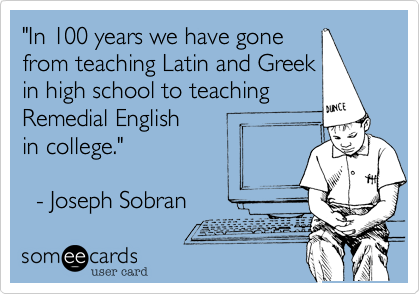
This postcard is sad but so true. I teach in a writing course, and probably 25-30% of our students are less than average at grammar. No doubt it's the same or higher in other courses. It's not their fault. They just aren't learning it at high school, or even primary school. They also have poor listening skills, and when I researched how to teach these skills, I discovered they were supposed to be taught in Grade 5.

Yes, learning grammar can be boring, but it's a lot easier at primary school to learn the fundamentals, a bit at a time, over a few years, than it is as an adult to have to learn it all in one year (which is most of our first year Editing unit). If you don't know how to construct a decent sentence and punctuate it clearly, you can't be a writer. (If you can't serve the tennis ball well and get it in the court, you can't be even a decent tennis player. Extrapolate that to any profession you like.)

The experts (our current Education minister, Pyne, seems to consider himself one, too, without any experience or qualifications) all have their own theories on what will "fix" this falling standards problem. I recommend they consult a writer friend of mine who also happens to be an 8th grade science teacher, who told us on FB the other day: "Since I've started taking my students to the library every two weeks I have two success stories-really it's their success story. One student has now checked out and read more books in the past two months than the prior 8 years of school. Another student who hated to read now has a positive attitude abut school and loves to read. It is true. There is a book for every child. It just takes time to find what the child likes and make reading fun-don't attach any tests, reports, etc. to it." Yay for her!

If a child can read, and if they enjoy it enough to keep reading (without being turned against it by not only tests and reports but also adults hassling them and parents expecting "progress"), I think this is the one thing that can make a crucial difference. Being able to read fluently means confidence, ability with language (it's no coincidence that our students with poor skills don't read much), higher comprehension of material and a whole host of other connected skills. If you read a lot, you can tell when a sentence isn't "right" - when the verb tense is wrong, or even that the full stop is in the wrong place. You can tell when a word is spelled wrongly because it also doesn't look "right". Reading well leads to this skill which then means you can fix your errors.

A person with poor language skills can't even write a decent application letter for a job. A person with poor language skills knows it. You don't have to be dumb or stupid to have poor language skills. You just have to have been put off reading at an early age, for one reason or another, and then been left behind. My theory (if Pyne can have one, so can I, and I bet I know more than him about it!) is that if we can get more than 90% of our kids to enjoy reading from their first years in primary school, and to keep that enjoyment going, with whatever books and materials we can, we might go a lot further in solving the slipping standards issue.

Add in those early grammar lessons (I'm not saying I enjoyed them, but they stuck, and I did always love reading) and we're on the way. And every time the issue comes up, we are always told to go and look at what Finland is doing. Here's one article about how they do it. It's clear they're doing exactly what my writer/teacher friend is - taking the time to find what works for each kid. That means letting teachers do their job instead of filling out another round of reports and justifying every thing they do with more paperwork.

Here in Victoria the government (Napthine and Liberal mates) seems to think the solution is to demonise teachers and make us believe they're all a bunch of rotten eggs who don't deserve any pay rises. The myths about teaching and teachers that they want to feed us are appalling. I think every politician who thinks he knows something about education or has a role in making up these fabrications should be made to go and teach in a Western Suburbs state school for a whole week. And do all the pointless paperwork!

Compelling first lines make a big difference

  People can often quote famous opening sentences from novels. They ring in the ears, with rhythm, intrigue and portent. “It was the best of...