I finished "On the Jellicoe Road" a few days ago, and the second half (thankfully) was much better. Then I thought about my earlier comments - had I started reading it at the wrong time, and therefore wasn't concentrating properly? (I read the first 30 pages while waiting to go in for a small operation, but I don't think the anaesthetic was the problem.)
So I went back and re-read the first few pages again, and decided it was a bit of both. No, I hadn't really been giving the book 100%, but I also felt the author could have made it so much clearer what was going on. For those of you contemplating reading this book, here are some useful clues:
1. The parts in italics are not the main character dreaming or talking or writing something. They are actually a novel written by another character about things that happened 22 years ago. I'm not spoiling the story by telling you this - I'm ensuring that you don't get totally confused.
2. The main character is in a boarding school for kids no one wants. One of the school girls is from the nearby town. Nobody else in the school is.
3. The whole basis of the action in the story is this kind of wargame between the boarding school kids, the town kids and another bunch of boys on cadet camp. Why 18-year-olds would be playing the kind of game that 12-year-olds get off on was a bit beyond me. That's my main "credibility gripe".
4. The main character, even though she seems to be the "dead loss/hopeless case" of the school, is somehow made the head honcho of all the kids (by vote). Another credibility issue.
I have no doubt that lots of readers will disagree with me on this book, but I really don't see what is the point of not making simple things clear to the reader.
Enough grumping and groaning. I've just finished last year's Newbery Award winner, "Kira-Kira" by Cynthia Kadohata, and totally enjoyed the voice and character of Katie. The story is mostly set in Georgia in the 1950s, and Katie is the younger daughter in a Japanese family. Mum and Dad work in the chicken factories, saving for a house, and the older girl, Lynnie, is Katie's idol. The voice is terrific - naive but genuine - and Katie's journey to understanding how to survive in a difficult world is gentle but profound. Good example of 'less is more' - very little overwriting (if any).
Marking? About 60% achieved so far. 30 short stories to go. It's a little like being a magazine editor, only instead of rejections or acceptances, I have to give feedback on what I think is or is not working. The kind of thing we secretly wish all editors would do for our submissions.
In the last class, I gave the students something I had written about getting published, what it means to write or just call yourself a writer (there's a big difference), how to improve, how to survive after you give up the support of classes and constant, immediate feedback, what perseverance really means - all that stuff. I might put it up on my website, if I can work out how to create my circles diagram in Word.
And in response to someone in the newspaper recently who criticised the use of the word "stuff" - it's a very handy word, useful in all situations. A bit like "thingy" - right, Sue?

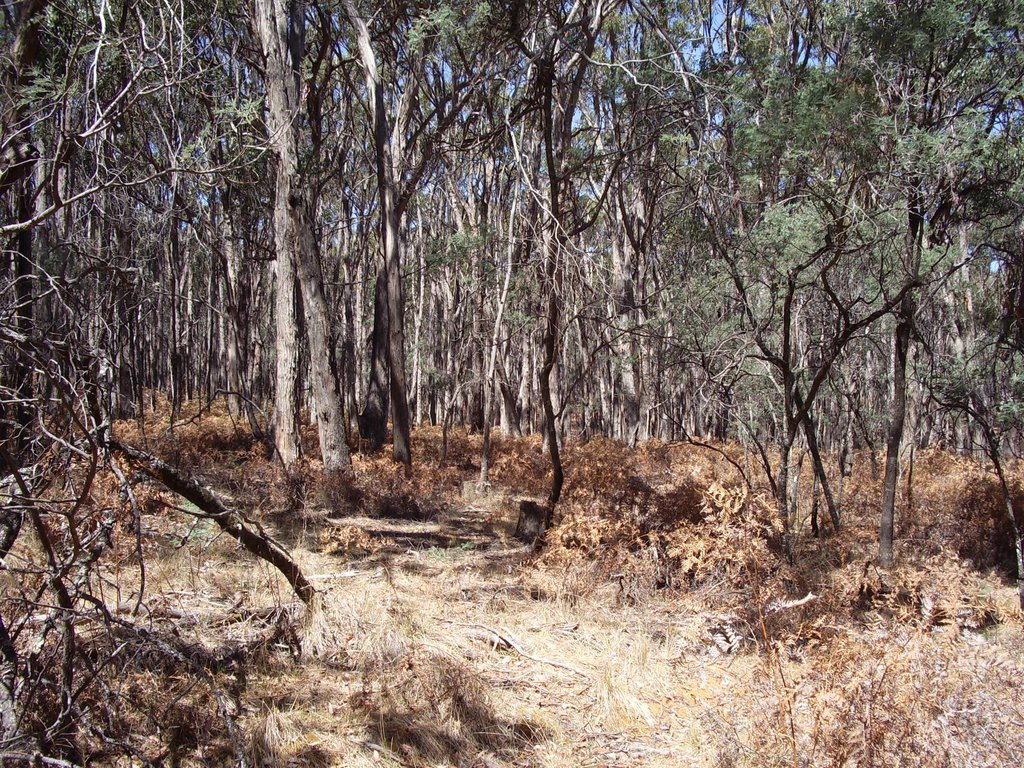 This the Australian bush right now. Even the bracken is dead. The leaves, twigs, dead bracken and fallen branches make a thick layer of fuel - one lightning strike or pyromaniac is all it takes. The lightning we can't do anything about. The pyromaniacs? If you live near bushland, keep an eye on it.