Sunday, December 07, 2014

Creating my own Nanowrimo

How many of you did Nanowrimo this year? It seemed to me that fewer people I knew tried it, but maybe that's just in my part of the world. (For those of you who don't know what this is, you sign on - for free - to write 50,000 words during the month of November - see www.nanowrimo.org .)

When everyone else (I imagined) was madly writing away on their novels, churning through 1668 words a day, I was ... not writing. Well, I was, but I wasn't writing fiction. I was pounding the desk and rubbing my aching head and thinking I was probably more than a tiny bit crazy, and working on my candidature document. This is a thing you have to produce about your PhD project, and then you present yourself in front of a panel who quiz you to see if you know what you're talking about. (Considering I often feel as though I am talking gibberish about all kinds of things, you can see why this was nerve-wracking.) Plus I was writing a talk about verse novels to give at a conference.

Nothing was further from my mind than fiction writing.

Actually, I lie about that. Fiction writing was right there, like a friendly dog waiting to be patted (or written). The more I tried to placate it by saying, "Soon", the snappier it got. Finally, I decided I needed to make a promise. So I told it, "I promise that on the 15th of December, you will have my absolute full attention for a whole month." And it stopped growling at me. Yes, I write poetry and I love metaphors!

Tomorrow is the 8th. I have a week in which to tidy up my life (in more ways than one - my office could be a metaphor for the Apocalypse), finish the academic reading I haven't gotten to yet so I can get those library books back before more fines descend on me, file the 80 articles I have compiled so far and then find the 15,000 words of the novel I wrote on my retreat back in August. I know I printed them out, I just have to find them (see Apocalypse, above).

But during this week I plan to do more than just tidy away all things that have been interrupting my writing for the past 2-3 months. Just knowing that in seven days I will be writing again, I'm already thinking about the novel, the characters, and the plot holes that have emerged. I'm working through new plot ideas, daydreaming about the world I've created, writing down notes, collecting ideas. I want to hit the ground running, not just show up next Monday and go - Now, where was I?

That's the problem with having to put aside a novel for a long period of time. You have to find your way back into its world again, get to know the characters, wriggle back inside your main character's skin or brain, do some "writing around the novel" to feel its wholeness and real-ness again, in order to make it real as you write it.

Once I start on the 8th, I hope to keep working every day on it (probably even Christmas Day, yes), until I have a complete first draft. I have no idea how long it will be but it's middle grade so likely to be around 55,000 words or so. I'm conducting my personal Nano at a time that suits me, with a definite goal in mind. I've done 28 day challenges quite a few times, so I know now that with plenty of thinking time included, I can write 1000-1500 words a day with momentum. That's the key - make a promise and get writing, keep up the momentum and before you know it, you have a novel!

Friday, November 07, 2014

Location, location, location - for writers

Recently, two writer friends and I went to the movies and saw "Love, Rosie" (when you have been doing 14 hour days and working really hard, it's amazing how much a fluffy movie can brighten you up). Of course, we all came out of the theatre picking apart the plot! But we also stayed to the end of the credits to find out where the movie was filmed because certain scenes didn't "feel right".

The location scout would probably be disappointed in us. After all, he/she found wonderful locations to film in Toronto and Ireland. The only problem was that the key scenes were supposed to be in Boston and on the coast of England. We stayed to check out of curiosity, me especially, because I've found over and over that despite Google maps and street view and all the photos and videos on the net, actually being in a place makes a huge difference to how you write about it.

For one thing, you get smells and sounds when you are there. You get action, people and what the place looks like in different seasons. But you also get to simply sit and immerse yourself, or walk and explore. How long does it take to walk down that street or across that moor? What does it feel like in the rain, or the burning sun? What does it feel like to walk in a thick fog, or complete darkness?

So when it came to this movie, there was something about the dark green of Ireland, the old rock wall, and the house-hotel that didn't feel like England. OK, I'm being picky, but that last part of the movie was significant - it was where the main character finally followed her dreams so the setting was as important as the dialogue and action.

Of course, some movies do this location thing wonderfully. Think Lord of the Rings in the South Island of New Zealand, or Gladiator (this quote from Wikipedia - "The opening battle scenes in the forests of Germania were shot in three weeks in the Bourne Woods, near Farnham, Surrey in England.. When Scott learned that the Forestry Commission planned to remove the forest, he convinced them to allow the battle scene to be shot there and burn it down.") On the other hand, I cannot imagine the Mad Max movies being shot anywhere except in the outback of Australia!

Setting is often the last thing that writers think about when they're in the first draft. It comes later, as the story is rewritten, but it's the choice of details that's telling, that shows you whether the writer really understands what's at stake. You have to help the reader feel as if they are there, and even more, you have to help the reader believe the character is there, seeing and understanding and reacting to that setting in ways that only they could. So maybe part of that being in your setting is also imagining yourself as the character and asking what they see, and how they feel about it.

So it may well be that in the next ten months, I'll be out near Broken Hill, or in the New Forest, or Chicago. All in the service of better writing!
(One day I'll figure out where to put this - below - in a story.)

Thursday, October 23, 2014

New YA novels

YA fiction is 'hot' this year, with studies showing more than half of readers are not actually teenagers. There have been articles decrying adult readers as juvenile, and others defending YA fiction as 'telling great stories', ones that people obviously want to read. So I thought I'd write a little about three recent novels (and yes, I'm a keen YA novel reader, and also a keen MG reader!).
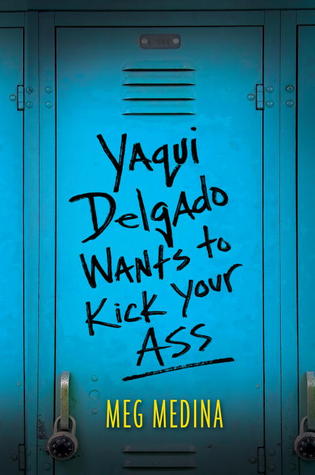
Yaqui Delgado Wants to Kick Your Ass - Meg Medina

Yaqui Delgado Wants to Kick Your Ass
Yes, I bought this book because of the title, but also because I had heard lots of great things about it. In a nutshell, it's a book about bullying, but it's not at all a 'do-good' story in the sense that these kinds of issues stories can sometimes be. The characters are mostly Latino, and the setting is a poor district high school. The main character, Piddy, has been forced to change schools when her mother moves them to a better apartment. When Piddy is greeted one day with 'Yaqui Delgado wants to kick your ass', she's flabbergasted. She doesn't even know who Yaqui is - but she is about to find out.

This is a story that takes bullying to a new level, the kind that frightens all of us. A girl who is obviously out of control and possibly psychotic decides she hates Piddy and becomes obsessed with beating her up. It reminded me of stories of women being stalked by an obsessive man - no matter what the woman does, he won't give up or listen to reason - and when reason fails, what are we left with? Nearly all of the characters in this story are female, and this is as much about Piddy's relationships with her mother and her friend, Lila, as the bullying. Piddy is a smart girl but when faced with personal violence, she is at a total loss. Of the two males in the story, one is an absent father (so absent that the mother refuses to mention his name) and the other is a boy whose own father is a monster. Medina weaves all of these threads together successfully, and the book kept me hooked all the way through.

The Impossible Knife of Memory - Laurie Halse Anderson

Anderson never flinches from telling the hard stories. Speak was about rape, Wintergirls was about anorexia, and now this story is about a teenage girl, Hayley, living with her war veteran dad, who is suffering severe PTSD. Hayley's mother died, and when Dad's relationship with Trish broke down, he took Hayley on the road with him for several years. Now they are back in his home town, living in the family house, and she is at high school, struggling to cope.
The Impossible Knife of Memory
As Dad moves in and out of 'episodes', Hayley is finding it harder and harder to deal with him. She is so caught up in caring for him that she fails to see that he is steadily getting worse. Her whole life is about protecting him and making sure nothing sets him off. She begins a relationship with a boy at school, the only one weird enough to 'get' her, as her friend says, but even he can't be allowed to get involved with her dad in any way. When Trish returns, Hayley tries to blame Dad's worsening condition on her. Eventually, of course, things come to a head.

Although this is a story specifically about the father's PTSD, as do many strong novels of this kind, it speaks to a much wider range of issues. Mostly I thought that Hayley gives us a really good idea of what happens when you are caught up with 'enabling' someone's condition because you are in so deep you can't see what is happening. It could apply just as well to alcohol and drugs. It's also a frightening depiction of a world in which the adult is no longer capable of being the caregiver and it all falls to the child. Despite sounding depressing, the story is well-balanced by Hayley's relationship with Finn - their funny dialogue serves to lift the darkness at just the right moments.

The Ocean at the End of the Lane - Neil Gaiman

The Ocean at the End of the LaneEven though I read this several months ago, it has stayed with me. I'm not an avid Neil Gaiman reader, like some people, but I liked the sound of this and so I picked it up. I'm not sure it's even YA, but Gaiman says it is definitely not a children's book because of the bath drowning scene. I would have to agree. He has said it is his most autobiographical book, set in the place where he grew up, with the family of Hempstocks who live at the end of the lane.

In an appearance at Symphony Space, he said, “While I was writing, it was like I was there. There’s a scene where our hero has to climb down a drainpipe to escape, and I was talking to my sister, and she said, ‘you know, we’ve got a photo of you on that drainpipe…’ And that’s the back cover of the book now!”

It's a story in which the boy is caught up in bizarre, almost-mythical events, things that terrify him and only Lizzie Hempstock is there to help. The pond is an ocean that holds terrors and monsters. But in the way that Gaiman often writes, it is the things going on in the family home that are more frightening. In a very different way, he raises the same question that Anderson does - what can a child do when his or her parent won't see reason and take care the way they are supposed to?
I can recommend all three of these books - they won't make you feel comfortable but they will catch you up and give you plenty to think about.